
It’s easy to assume that if you sign up to a discounted tariff, you’ll pay that lower rate for all of your electricity throughout the year. But in certain cases, that’s not how the discount works. For some Power NI bill pay tariffs, discounts are capped at a maximum annual value.
Instead of applying a lower unit rate for 12 months, these tariffs provide a maximum annual discount (for example £60). Once that discount has been fully used, any additional electricity is charged at the higher standard rate.
Following the latest Power NI price increase (1st July 2026), households will reach these discount limits sooner than before. It’s an important detail that many people don’t realise – and one that can affect the true cost of your electricity over the year.
How does Power NI’s discount work?
Power NI offers discounts depending on how you pay and whether you choose online billing.
For example:
- Monthly Direct Debit with online billing: up to £60 discount per year
- Quarterly Direct Debit with online billing: up to £46
- Monthly Direct Debit: up to £40
- Standard with online billing: up to £20
Unlike many energy tariffs, where a discounted unit rate applies throughout the tariff term, these discounts have a maximum annual value. Once that annual discount has been fully used, any additional electricity is charged at the Power NI standard rate, which will be more expensive.
Power NI clearly sets out its discounts and rates: however, many consumers may (understandably) assume the discounted rate applies for the full year when, in practice, it only applies up to a certain value.
A real example:
Monthly Direct Debit with online billing
From 1 July 2026, Power NI’s Monthly Direct Debit with online billing tariff includes:
- Discounted rate: 32.10p/kWh
- Standard rate: 34.15p/kWh
- Maximum annual discount: £60
That means the £60 annual discount is fully used after: 2,927 kWh per year.
Up to this point, electricity is effectively charged at the discounted rate.
After this point, the standard unit rate applies.
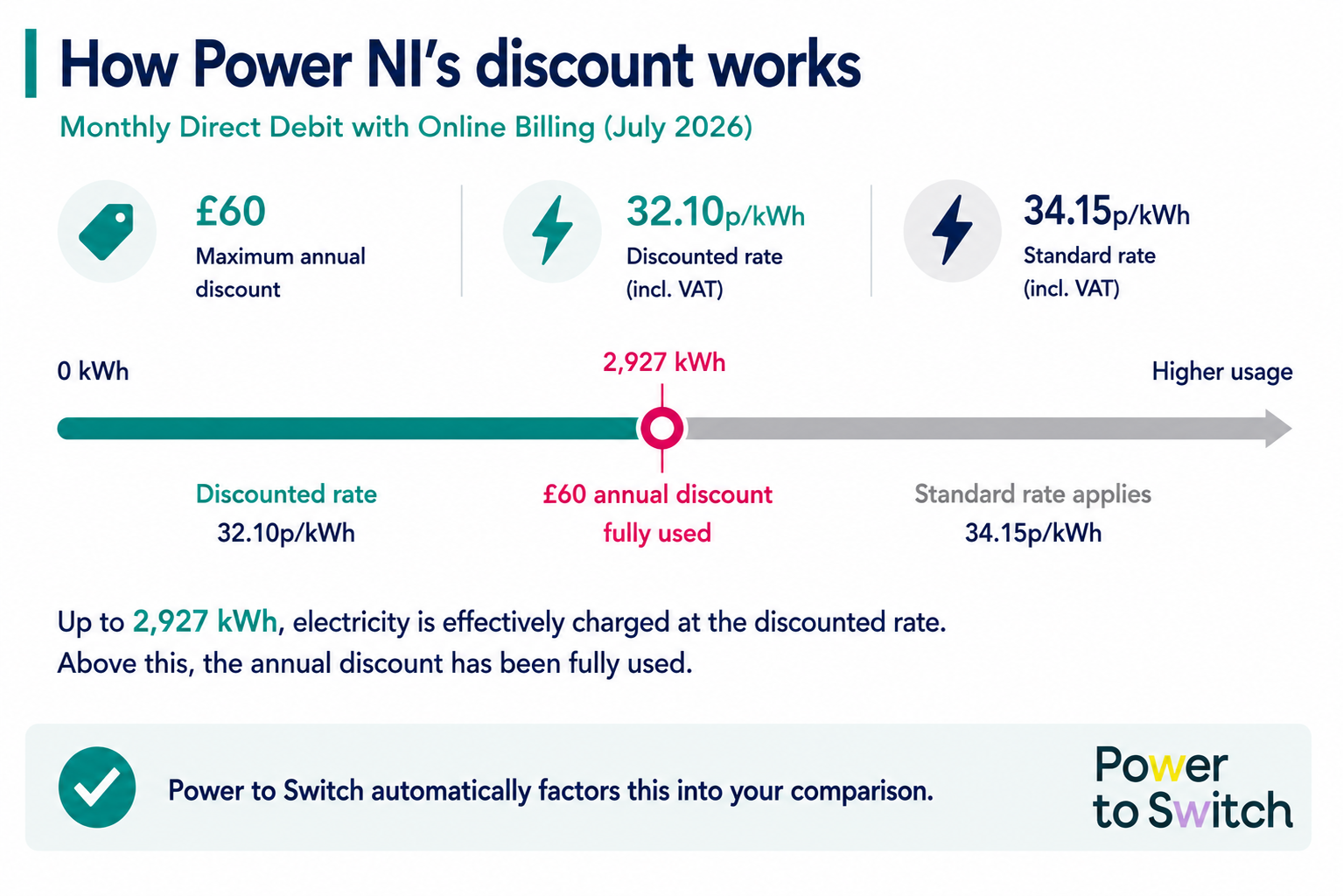
As electricity prices have increased, households now reach the discount limit sooner, meaning more electricity may be charged at the higher standard rate. Many homes will use more than 2,927kWh in a year – in fact 3,200kWh would be deemed average usage.
Why this matters
The average Northern Ireland household uses around 3,200 kWh of electricity each year.
This means many households will use more electricity than the 2,927 kWh discount threshold on this tariff.
Higher-usage households, such as larger families, electronic vehicle (EV) owners and people working from home may reach the maximum discount even earlier.
Following the latest Power NI price change on 1st July 2026, households will now reach these discount limits more quickly, because the fixed annual discount is spread across fewer units of electricity.
How much electricity can you use before the discount runs out?
Below are the annual thresholds levels for Bill Pay tariffs based on Power NI’s July 2026 rates.
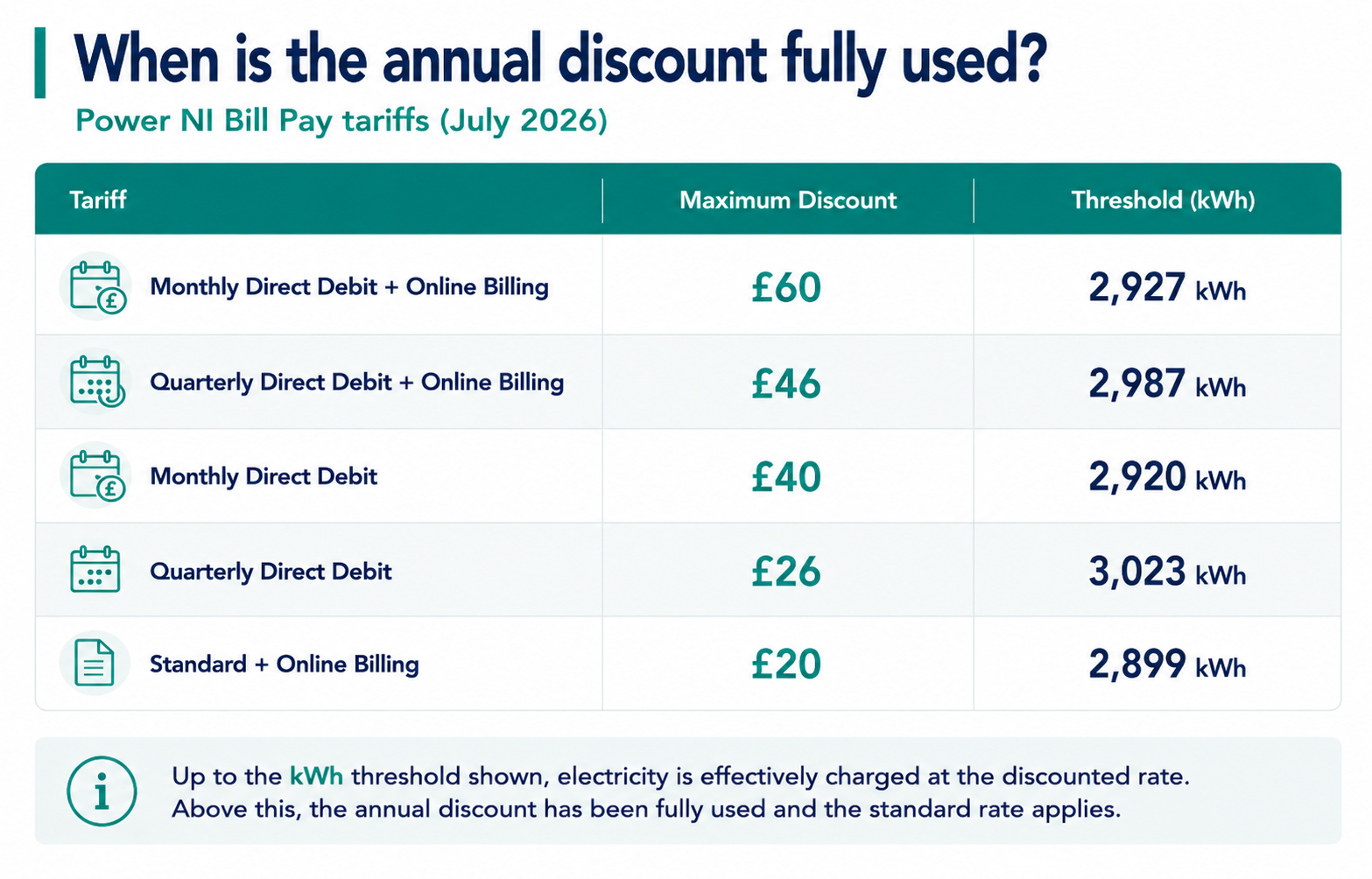
*Thresholds based on current July 2026 tariff rates.
The thresholds equally apply to Power NI Economy 7 customers.
As these customers may be charging an EV or using electric heating, they may consume more electricity than an average home. Because Economy 7 tariffs include separate day and night unit rates, the exact threshold depends on how much electricity is used during each period.
However, the key point remains the same: once the maximum annual discount has been fully used, additional electricity is charged at the standard rate.
How Power to Switch handles this
When comparing electricity tariffs, it’s important to compare the total annual cost, not just the advertised unit rate.
Power to Switch automatically applies the annual discount into your comparison.
Rather than assuming the discounted rate applies for the full year, we calculate:
- when the discount threshold is reached
- when standard rates apply
- the true annual cost based on your electricity usage
For example, where a tariff has a reach its annual discount, Power to Switch explains:
“Power NI provides a maximum discount per year. Energy usage up to this threshold is charged at the discount rate. Any usage above this is charged at the standard rate. This has been factored into your comparison.”This ensures our results reflect what you are actually likely to pay, rather than relying solely on headline rates.
The key takeaway
Discounted electricity tariffs can still offer good value but understanding how they work matters.
Many tariffs offer a discount for a fixed term (12 months), but if a tariff applies a capped annual discount, the discount rate may not apply to all the electricity you use across the year.
That’s why it’s important to compare tariffs based on your actual annual usage. And it’s why Power to Switch goes further to make sure comparisons reflect the real cost to your household.