
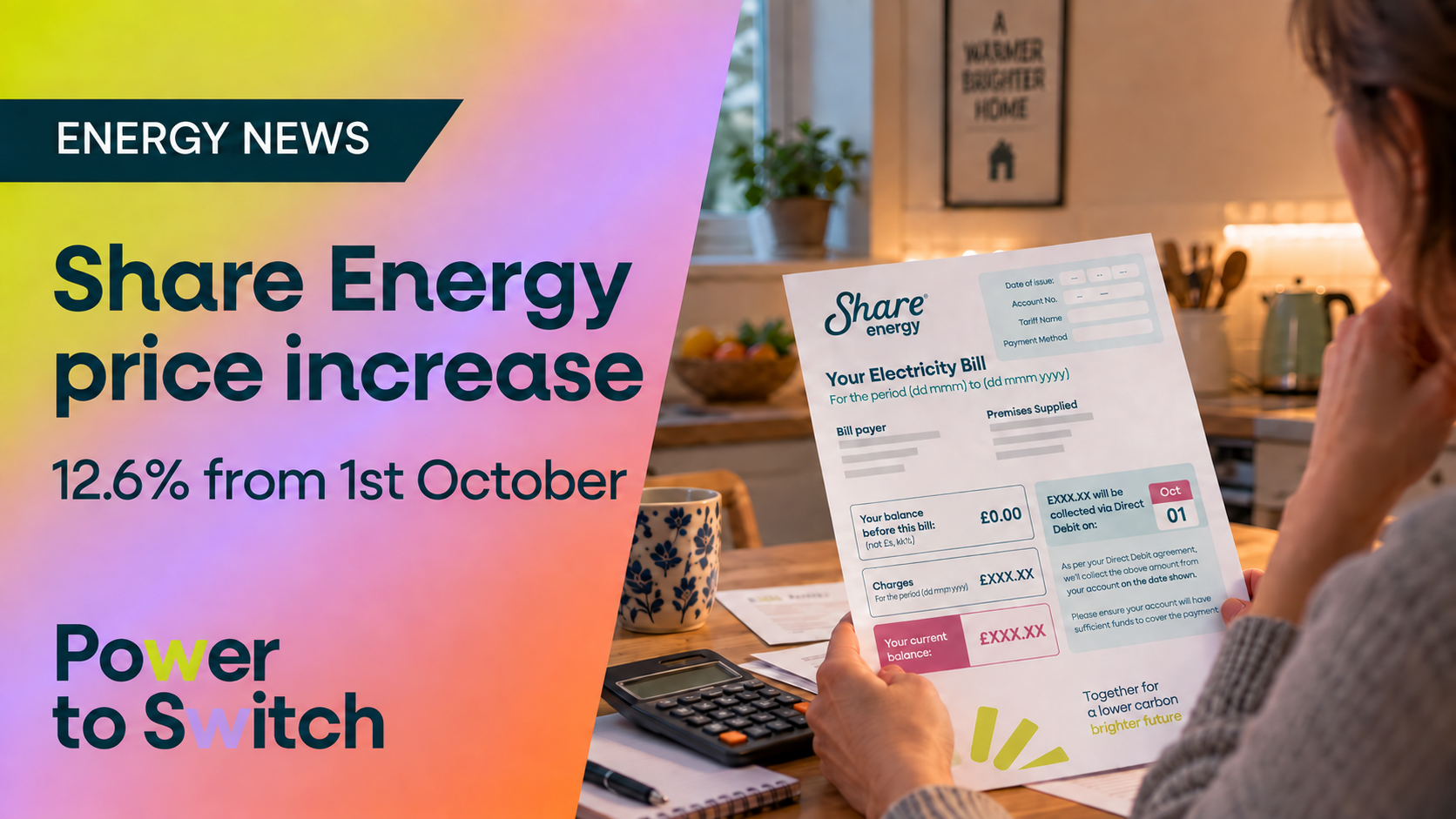
Share Energy has announced an electricity price increase for customers in Northern Ireland, with rates set to rise by 12.6% from 1st October 2026.
For a typical household, the increase will add around £129 a year to electricity costs. Share Energy’s daily standing charge for 24Hr tariffs will remain unchanged (Economy 7 Standing Charges will increase).
With other electricity suppliers increasing prices or removing discounts, it’s a clear signal that rising wholesale energy costs are impacting on household bills once again.
What does the price increase mean for customers?
Share Energy’s new prices will take effect from 1st October 2026.
The increase will see the annual bill for a typical 24Hr meter customer (bill pay and keypad) rise by around £129 per year. The increase will mean that the annual electricity bill for a credit customer will cost £1,200 and £1,213 for a keypad customer.
Share Energy have confirmed that there will be no change to the daily standing charges (p/day) for 24Hr Bill Pay and Keypad customers. The changes in rates and charges are already factored into the results on Power to Switch.
What about Economy 7, Eco and EV customers?
Share Energy’s Economy 7 tariffs have proved particularly popular with EV owners and households able to shift more of their electricity use into cheaper night-time periods.
Customers on Economy 7 (or Shares Eco / EV tariff) will also see prices increase from 1st October (including Standing Charges). These tariffs have separate day and night rates, so the impact will depend on when customers use their electricity. For a typical household using 3,200 kWh a year, based on a 60% Day / 40% Night usage split, the new prices would add around £106 a year to the annual electricity bill.
For EV owners in particular, the actual impact could be different depending on how much charging is done overnight, when the lower night rate applies.
Share Energy – a relatively new supplier in Northern Ireland
Share Energy is the most recent electricity supplier to enter the Northern Ireland domestic market, launching in September 2024.
At the time, its arrival was seen as an important development for competition in the market, giving consumers another option beyond the more established suppliers. The company has grown quickly to around 40,000 with customers highlighting its competitive pricing, straightforward tariff structure and 50:50 profit share model.
In April 2026, Share Energy introduced its first price increase since entering the Northern Ireland electricity market. That change added around £213 a year to the bill of a typical Bill Pay or Keypad customer.
What should households do now?
Energy prices are changing again, but that doesn’t mean households simply have to accept paying more.
There continues to be a wide range of electricity tariffs and offers available across Northern Ireland, and the cheapest deal can change as suppliers update their prices and discounts.
A few simple steps can help:
- Check which supplier and tariff you’re currently on and what you’re paying.
- Compare your current annual cost against the other deals available.
- If you have Economy 7, an EV tariff or a Keypad meter, make sure you’re comparing tariffs designed for the way you actually use electricity.
Put simply, while you can’t control wholesale energy prices, you can make sure you’re not paying more than you need to for your electricity.
At Power to Switch, we compare tariffs and deals from all electricity suppliers in Northern Ireland to help you find the best option for your home.
Compare all the latest electricity tariffs and switch supplier in just a few minutes using Power to Switch
* typical customer is based on an average household usage of 3,200 units (kWh) per year.